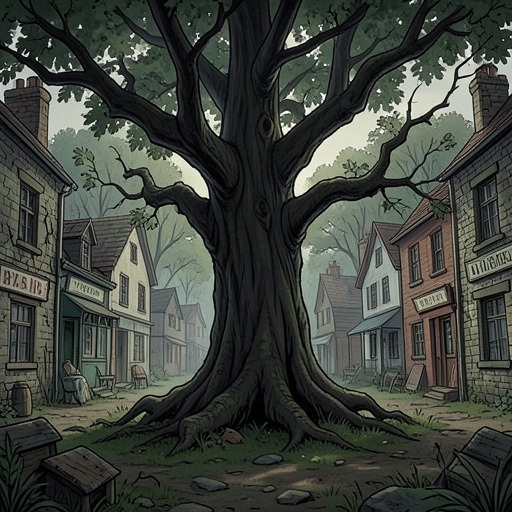
Bradley Colson
The TommyknockersBradley Colson is the fast-talking revival preacher whose 1900 campaign in Ilium culminates in a new name for the town: Haven. He makes the language of harvest, divine promise, and sanctuary sound like a description of the place itself, then leaves with money and sexual conquests. His most lasting achievement is therefore also an irony: the town keeps the name bestowed by a man its minister regarded as a thief, fornicator, and false prophet, while the revival’s consequences include a family murder and suicide.
Identity and arrival
Colson arrives in Ilium rather than Derry and gathers much of the town’s Christian population around a lively, emotionally charged version of faith. The town’s self-appointed historian, Myrtle Duplissey, eventually becomes convinced that Colson is not his real name and that he is the illegitimate son of Albion Cooder. The account preserves this as her later conviction, not as a certainty about his identity; the preacher is known to the town as Colson.
His rise unfolds against a remarkable agricultural season. As summer 1900 draws toward its end, the northern New England soil produces an almost inexhaustible bounty, and Colson makes the harvest central to his appeal. Meanwhile, religious meetings in the tent beside Derry Road grow louder and more ecstatic. Methodist minister Mr. Hartley sees his usually restrained parishioners speaking in tongues and engaging in holy rolling, and recognizes in the fervor a force capable of unsettling the town’s established religious life.
The sermon and the naming of Haven
On a hot August night, Colson begins with the harvest as a symbol of God’s reward and turns from the crops to the town. Sweating, with his hair fallen into his eyes, he grips the pulpit and declares Ilium sanctified, calling it a haven and comparing it to the land Adam and Eve knew before they ate the forbidden fruit. The congregation answers him with an amen. His claim is not merely devotional: it makes a religious image into an argument about the town’s identity.
Colson then asks why a town promising God’s harvest and haven should bear a name associated with an Italian, blaming the devil for the existing name. Talk of changing Ilium to Haven begins the next day. The proposal meets resistance: Hartley opposes it forcefully, while Baptist minister Mr. Crowell protests listlessly; the selectmen are neutral and point to the expense of changing incorporation papers, signs, and stationery. Colson’s sermon has nevertheless supplied a memorable justification for the change, connecting agricultural abundance and divine shelter to a fresh civic name.
The rhetoric also reveals how Colson’s authority works. He presents the place as specially chosen and sanctified, and the crowd’s enthusiastic response turns his private claim into a shared public feeling. In this way, a revival preacher’s language outlasts the revival itself: the new name attaches the town to the promise he proclaimed even after his own conduct makes that promise look compromised.
The Harvest Home Revival and flight
Colson builds anticipation for what he calls the great Harvest Home Revival of 1900, describing it as the most important meeting he will hold that year—and perhaps the most important of his life. He even suggests that God may be calling him to settle in town, news that pleases his female admirers. He presents the final meeting as a love-offering to the God who has given Ilium its extraordinary growing season and harvest.
The offering has both financial and personal dimensions. Colson cajoles the audience into giving the largest love-offering of his stay; after the meeting, he has sex with six young women in the field behind the tent. The gathering runs late: preaching continues until ten, gospel singing until midnight, and the encounters in the field until well past two. Local accounts disagree about exactly how much money Colson collects, but agree that the congregation has already supported him generously. Women compete to bring his meals, the proprietor lends him a buggy for a long period, and his nightly entertainments cost him nothing.
Colson leaves on the night of September 7. By the morning of September 8, both preacher and tent are gone. His departure turns the revival’s language of harvest into a pointed double image: he has spoken of God’s bounty while also gathering money and sexual partners for himself. The story’s sardonic account of his “harvesting” makes the gap between religious promise and personal conduct impossible to miss.
Aftermath and legacy
The consequences extend beyond Colson’s overnight disappearance. Between January 1 and the town meeting in late March 1901, nine illegitimate children are born in the area—three girls and six boys. Local gossips observe that all nine have thick black hair at birth, and six have blue eyes. Rumors also circulate about young women sent away to visit relatives and about married women who give birth during the same period. The account makes the preacher’s sexual reach part of the town’s public memory, though it does not establish the circumstances of every pregnancy.
The most brutal aftermath occurs on March 29, two days after the town votes to change its name. After Faith Clarendon gives birth to a boy with thick blue-black hair, her husband Paul stands silently over the crib for more than an hour. The midwife, Cora Simard, mistakes his fixed stare for wonder and love. When she wakes, Paul has taken a straight razor and cut the baby’s throat. He then goes to the bedroom, cuts Faith’s throat, lies beside her, takes her hand, and cuts his own. The account does not identify the child as Colson’s, and the connection between the revival’s pregnancies and this particular family tragedy remains unconfirmed. Its placement after the town’s vote nevertheless binds Colson’s legacy to the human wreckage remembered in the aftermath of the revival.
Hartley remains dead-set against naming the town after a man he considers a thief, fornicator, false prophet, and snake in the grass. He expects Article 14, the proposal to change Incorporated Maine Town No. 193 from Ilium to Haven, to be voted down. At the March 27, 1901, town meeting, however, the article is put to the meeting and the name change passes; Hartley never realizes that the outcome is in danger until it is too late to intervene. Colson is long gone by then, but his chosen name has acquired a civic life beyond his control. The transformation from Ilium to Haven preserves the sermon’s language of sanctuary while its origin remains bound to a preacher whose own conduct violated the moral authority he claimed.
Narrative significance
Colson’s episode joins religious performance to the making of local history. His harvest sermon does not simply describe a town as blessed; it persuades listeners to imagine that blessing as part of the town’s permanent identity. The ensuing vote makes that image material in official naming, while the crowded meetings, love-offering, and women’s attention show how spiritual authority is also sustained by money, hospitality, and desire.
The narrative’s account is deliberately double-edged. Colson can still be remembered as a man who knew how to shout for Jesus, even as later judgment calls him a fraud and a predator. That contrast helps explain how the name Haven can endure without vindicating its origin: a town may inherit the powerful symbol a preacher supplied while also inheriting the shame, gossip, and violence that his brief occupation left behind.